
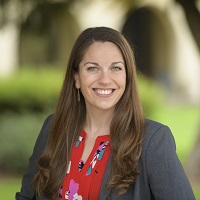
Erin Smith, PhD
Professor of Psychology
Fletcher Jones Endowed Professor of Research
Director of Research, College of Behavioral and Social Sciences
Office Phone: 951-552-8626
E-mail: esmith@calbaptist.edu
Office Location: Cottage 18
Office Hours: As posted
| Degree | Major Emphasis | Institution | Year |
|---|---|---|---|
| PhD | Developmental Psychology | University of California Riverside | 2011 |
| MA | Developmental Psychology | University of California Riverside | 2008 |
| BA | General Psychology | Point Loma Nazarene University | 2006 |
PSY328 Cognitive Psychology
Science and Religion
鈥� Cultural and cognitive explanations for the development and differentiation of fantastical, scientific, and religious concepts
鈥� Relation between scientific knowledge and religious beliefs
鈥� The contribution and limits of science, especially neuroscience; philosophy of science
鈥� Psychological and cultural explanations for Christian engagement in science
鈥� The relationship and underlying processes between religious belief, virtue development, and health
Church as Social Support
鈥� The direct and indirect effect of supportive relationships at church on children鈥檚 development
鈥� Qualities and characteristics of churches with high levels of social support
鈥� Church as a source of resiliency in children鈥檚 experience of adverse/traumatic events
Scholarship on Teaching and Learning
鈥� Educating for productive science-religion dialogues
鈥� The development of critical thinking in college
鈥� Translation of cognitive psychology principles of learning into classrooms
University of California, Riverside
Foreign Language School, Zhejiang Province, People's Republic of China
High School English, Yunnan Province, People's Republic of China
More information about Dr. Smith's research interests and publications can be found on her website: erinsmithpsychology.com
鈥�2022-2023: Scholar in Residence, Southeastern Baptist Theological Seminary
鈥�2019-2021: Science Advisor through AAAS' Science in Seminaries Project, Dialogue on Science, Faith, and Ethics, https://www.scienceforseminaries.org/
鈥articipant in the Bridging the Two Cultures of Science and the Humanities 2015-2016 Project, through Scholarship & Christianity in Oxford (SCIO), the UK Centre of the Council for Christian Colleges and Universities (CCCU), funded by the Templeton Religion Trust.
Selected Publications:
鈥mith, E. I. (2023). Neuroscience and self in interdisciplinary dialogue. Perspectives on Science and Christian Faith, 75(1), 2-15. https://doi.org/10.56315/PSCF3-23Smith
鈥mith, E. I. (2021). A tale of two perspectives: How psychology and neuroscience contribute to understanding personhood. [Special Issue]. Scientia et Fides, 9(2), 25-53.
鈥mith, E. I. & Crosby, R. G. (2021). The effect of socially supportive church ministry on children鈥檚 prosocial behaviour: An experimental study of Latin American Protestant Congregations [Special issue]. Journal for Prevention and Intervention in the Community. Advance online publication. https://doi.org/10.1080/10852352.2021.1924591
鈥mith, E. I., Yoon, D. P., Bruininks, P., Witvliet, C. V. O., Cohen, D., Edman, L., Bankard, J., & Johnstone, B. (2021). Relationships between psychometrically distinct Brief Multidimensional Measure of Religiousness/Spirituality (BMMRS) factors and mental health among U.S. college students. Mental Health, Religion, and Culture, 24(2), 211-225. https://doi.org/10.1080/13674676.2021.1871596
鈥rosby, R. G., Smith, E. I., LaChausse, R. G., Blanchette, L., & Palardy, G. J. (2021). Practices of supportive church children鈥檚 ministries: An exploratory multilevel investigation of Church of the Nazarene congregations in the United States. Review of Religious Research. Advance online publication. https://doi.org/10.1007/s13644-021-00446-1
鈥rosby, R. G., Smith, E. I., Gage, J. & Blanchette, L. (2021). Trauma-informed children鈥檚 ministry: A qualitative descriptive study. Journal of Child and Adolescent Trauma. Advance online publication. https://doi.org/10.1007/s40653-020-00334-w
鈥mith, E. I. (2020). The role of psychology in advancing dialogue between science and Christianity. Perspectives on Science and Christian Faith, 72(4), 204-221.
鈥mith, E. I. (2017). Thinking like a psychological scientist. In R. Biswas-Diener & E. Diener (Eds), Noba textbook series: Psychology. Champaign, IL: DEF publishers. DOI: nobaproject.com.
鈥mith, E. I., & Crosby, R. G. (2017). Unpacking religious affiliation: Exploring associations between Christian children's religious cultural context, God image, and self-esteem across development [Special Issue: Religion, Culture, and Development] British Journal of Developmental Psychology, 35(1), 76-90. doi: 10.1111/bjdp.12156
鈥rosby, R. G., & Smith, E. I. (2016). Measuring children's church-based social support: Development and initial validation of the Kids' Church Survey. Social Development, 26(2), 423-442. doi: 10.1111/sode.12198
鈥ichert, R. A., & Smith, E. I. (2011). Preschoolers' quarantining of fantasy. Child Development, 82, 1106-1119.
鈥ichert, R. A., & Robb, M. B., & Smith, E. I. (2011). Media as a social partner: The social nature of young children's learning from screen media. Child Development, 82, 82-95.
Member of South Hills Church, Corona
My husband and I have been married since 2005; we have three children (born in 2013, 2015, and 2019) and two cats. (Cat person, here.) I love spending time with my family, adventure traveling (when that's a thing), fitness, reading, and game nights. I'm not presently caught up on the most recent season of My Hero Academia, so no spoilers, please.
鈥淚t has again brought home to me quite clearly how wrong it is to use God as a stop-gap for the incompleteness of our knowledge. If in fact the frontiers of knowledge are being pushed back (and that is bound to be the case), then God is being pushed back with them, and is therefore continually in retreat. We are to find God in what we know, not in what we don鈥檛 know; God wants us to realize his presence, not in unsolved problems but in those that are solved.鈥� Dietrich Bonhoeffer, 1972, Letters and Papers from Prison, Enlarged Edition. New York: Macmillan.
鈥淎nd I will lead the blind in a way they do not know, in paths that they have not known I will guide them. I will turn the darkness before them into light, the rough places into level ground. These are the things I do, and I do not forsake them.鈥� Isaiah 42:16 (ESV)